
Graham Bennett, Lerners LLP (Kitchener)
The profusion of ebikes and scooters, as well as the controversial decision of the provincial government in Ontario to remove the bike lanes on Bloor Street, University Avenue, and Yonge Street in Toronto has resulted in increased media coverage of safety concerns for those modes of transportation. Pedestrian injuries should also be a concern in our communities, where in most cases, priority is given to motorized vehicles. Earlier this month, the New York Times ran a piece asking why older pedestrians, in particular, fare so much worse when they are hit by a car. The gist of the article is this: older Americans are not struck more often than the rest of us. They are simply far more likely to die when they are.
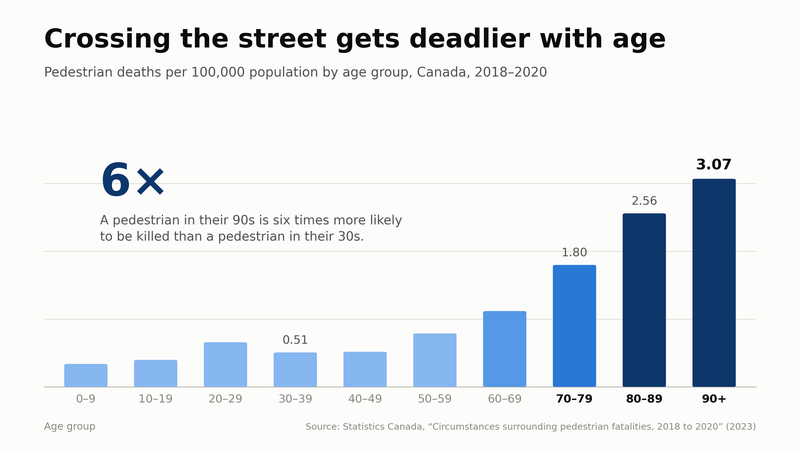
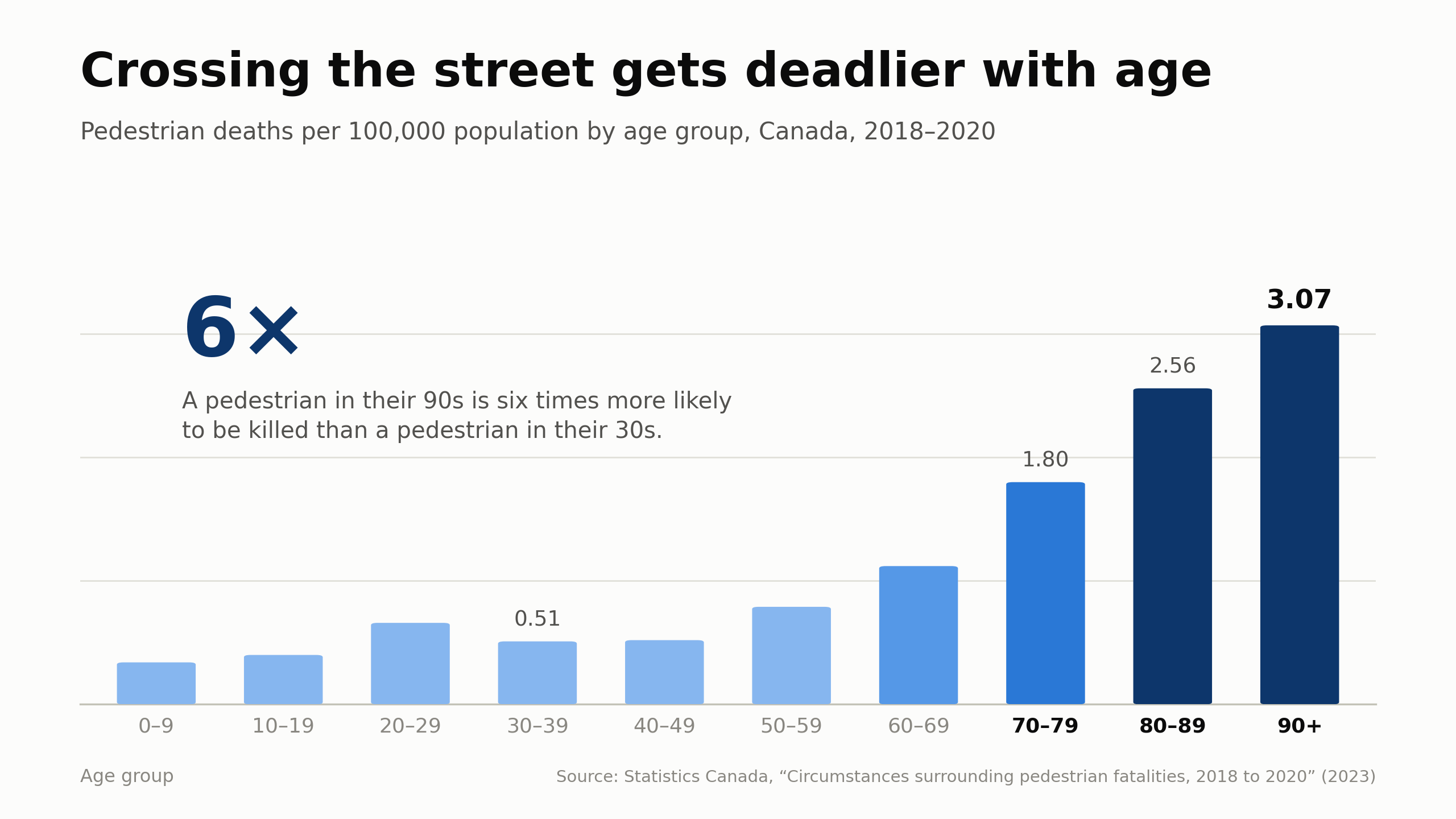
I wondered whether the Canadian numbers tell the same story. On the question of dying, they do – although our data do not tell us whether injury rates are equal across age groups, as the American figures suggest. Statistics Canada found that the pedestrian death rate climbs steadily with age – 0.51 deaths per 100,000 people aged 30–39, rising to 1.80 for those 70–79, 2.56 for those 80–89, and 3.07 for people 90 and older. StatCan’s conclusion was blunt: seniors 70 and older are the group most at risk of a fatal pedestrian collision.
Ontario’s numbers are consistent. In 2022, 106 pedestrians were killed by motor vehicles on Ontario roads – about one in six of the province’s 623 road deaths that year – and 35 of them, almost exactly one-third, were aged 65 or older.
Part of the explanation is perception and pace. Vision, hearing, balance, and reaction time all change with age, and a wide crossing timed for a brisk walker is a very different proposition at 80 than at 30. But the larger part is physics and physiology. A 2021 review of 60 studies covering more than a million pedestrians found that injured pedestrians over 60 had 1.6 times the risk of severe injury and 3.7 times the risk of death compared with younger pedestrians, though the authors rated the quality of the underlying evidence as low. A 2011 American study for the AAA Foundation put it in practical terms: a 70-year-old struck at about 40 km/h faces roughly the same average risk of severe injury or death as a 30-year-old struck at about 56 km/h. Same crosswalk, same car, very different outcome. As one injury epidemiologist told the Times, “A hip fracture in a 45-year-old is unfortunate. In a 75-year-old, it’s tragic.”
It may be tempting to tell older people to be more careful, which is rather like telling them to be younger. The better response is to design roads for (all) the people who actually use them: crossing signals timed to real walking speeds, pedestrian head starts at intersections, refuge islands on wide roads, good lighting, and speed limits that reflect what a human body can survive. There is also a case for concentrating those measures where older pedestrians actually walk – around hospitals, pharmacies, health facilities, and community centres – much as we already do around schools. The gap between 40 km/h and 56 km/h is the gap between a survivable mistake and a fatal one.
We have spent fifty years making vehicles remarkably safer for the people inside them. An aging country now has to take the same interest in the people outside them. I act for people – motorists and pedestrians – injured on Ontario roads, and behind every one of the pedestrian cases is usually a person who was just trying to cross the street.